Tai Chi is more than a series of slow, controlled movements. Rooted in Chinese martial arts traditions, it combines balance, coordinated breathing, and precise body mechanics with principles of self-defense. From learning basic stances and traditional forms to developing fluid footwork and controlled transitions, training improves coordination, stability, and body awareness. Whether practiced for fitness, relaxation, or martial arts training, Tai Chi offers a practical way to explore both the physical and technical aspects of this centuries-old discipline.
A tai chi instructor asks a student to step forward without shifting their weight too soon. The student leans into the movement, loses balance for a moment and quickly puts the other foot down. On the next attempt, the instructor asks them to keep their weight on the supporting leg until the forward foot reaches the floor.
It is a small correction, but the difference is noticeable.
Tai chi is full of moments like this. From a distance, the practice may look like gentle exercise. Yet a slow turn or a simple step can reveal problems with balance, posture and coordination that are easy to overlook during ordinary movement.
The art developed within Chinese martial traditions, although many people now practice it for mobility, relaxation or general fitness. Its techniques still reflect that background, even in classes where fighting is never discussed.
What Is Tai Chi?
Tai chi, also known as taijiquan, is a Chinese martial art based on coordinated movement, controlled weight transfers and changes in body position. Traditional training includes solo forms, partner exercises, strikes, joint controls and throws.
Most beginners encounter tai chi through slow movement sequences. The pace allows students to examine their posture and notice unnecessary tension without having to perform techniques at fighting speed.
Slow movement is a training method, not a requirement for every application. Traditional tai chi also includes quick turns, sudden changes of direction and explosive techniques.
Tai chi belongs to the Chinese internal martial arts, alongside Xingyiquan and Baguazhang. This traditional classification emphasizes coordinated body mechanics and particular approaches to generating and managing force. It does not mean physical strength is unimportant.
Modern instruction varies. Some classes concentrate on exercise and movement quality, while martial arts schools may include push hands, practical applications and resistance training.
History and Origins of Tai Chi
Tai chi’s early history combines documented developments with traditional accounts that are difficult to verify.
One famous legend credits the Daoist figure Zhang Sanfeng with creating the art after observing animals in combat. The story is associated with the Wudang Mountains, but historians have not established it as a factual explanation of tai chi’s origins.
Much of the documented development of modern tai chi leads to Chenjiagou, a village in China’s Henan province. The Chen family maintained a martial tradition that influenced several later styles.
Chen Wangting, a seventeenth-century martial artist, is traditionally credited with developing important elements of Chen family boxing. The precise relationship between these early methods and modern taijiquan remains debated.
During the nineteenth century, Yang Luchan studied Chen family martial arts and later taught in Beijing. His approach became the foundation of Yang-style tai chi.
Other traditions developed through subsequent generations, including Wu, Wu (Hao) and Sun styles.
Tai chi reached a broader public during the twentieth century. In 1956, Chinese authorities introduced a standardized 24-form routine based mainly on Yang-style movements. This shorter sequence helped make introductory instruction more accessible and remains widely taught.
How Tai Chi Works as a Martial Art
Someone standing rigidly may resist a push in one direction but struggle when the pressure changes. Tai chi training explores how to maintain balance without relying entirely on muscular resistance.
Practitioners learn to adjust their position, recognize changes in pressure and use coordinated movement to influence an opponent’s balance.
Similar principles appear in wrestling and judo. Tai chi develops them through its own movement patterns and partner exercises.
One traditional concept is song, commonly translated as relaxation or release. It refers to reducing unnecessary muscular tension while preserving the structure needed for movement and stability.
Another is fajin, the coordinated generation and release of force. Chen-style forms often demonstrate this through sudden, powerful movements following slower transitions.
Push hands, or tui shou, develops sensitivity to pressure and timing through controlled partner contact. Beginners may practice fixed patterns with limited foot movement. More advanced exercises introduce stepping, changes of direction and attempts to disturb the partner’s balance.
Traditional tai chi techniques also include palm strikes, punches, joint controls and throwing methods. Individual movements may have several applications depending on distance and positioning.
Learning solo forms does not automatically produce fighting ability. Applying techniques against resistance requires appropriate partner training and experience.
Main Tai Chi Styles and Forms
Tai chi styles share historical connections, but their movements are not identical. Differences appear in posture, stepping patterns, rhythm and the use of explosive force.
Yang, Chen and Wu Styles
Yang style is widely practiced in community classes and traditional schools. Its forms generally use broad, continuous movements performed at a steady pace.
The apparent simplicity can be deceptive. Maintaining alignment through a long sequence requires concentration and muscular endurance.
Chen style combines slow, spiraling movements with sudden changes of speed. Its forms include coiling actions, explosive techniques and stances that may be practiced at different depths.
Wu style, particularly the tradition associated with Wu Jianquan, often features compact movements and distinctive body alignment. Some postures involve a forward inclination of the torso while maintaining balance through the supporting leg.
Sun style is recognized for relatively upright postures and agile stepping. Wu (Hao) style generally emphasizes compact movements and precise weight transfers.
These descriptions identify broad characteristics. Individual lineages and instructors may teach noticeably different variations.
Short and Long Tai Chi Forms
A tai chi form consists of movements performed in a set sequence. Each transition connects one posture to the next through coordinated stepping, turning and arm movement.
Short forms make introductory training more manageable. The standardized 24-form routine is particularly common because it introduces recognizable techniques without requiring students to memorize an extensive sequence.
Traditional Yang-style long forms may contain 85, 103 or 108 counted movements, depending on the lineage and counting method. These numbers do not necessarily indicate major differences in length or complexity.
Chen-style training includes Laojia Yilu, commonly taught as a foundational routine, and Erlu, also called Cannon Fist. The latter places greater emphasis on vigorous movements and explosive techniques.
Longer forms demand sustained concentration, but their value depends on movement quality rather than the number of postures memorized.
Basic Tai Chi Techniques and Movements
Traditional tai chi movements often have descriptive names reflecting their appearance or historical associations.
Parting the Wild Horse’s Mane combines stepping, turning and coordinated arm actions. White Crane Spreads Its Wings involves a characteristic arrangement of the arms and a change in body position.
Wave Hands Like Clouds uses repeated torso rotations and sideways stepping. The arms follow coordinated circular paths as the body transfers weight between the legs.
Brush Knee and Push combines a clearing action with a forward palm movement. Correct timing matters because the arms, torso and stepping leg must work together.
These tai chi techniques have different martial interpretations. In introductory classes, however, instructors usually concentrate on the mechanics needed to perform them safely and consistently.
Stances, Balance and Movement
Tai chi uses several recognizable stances, each serving a different purpose.
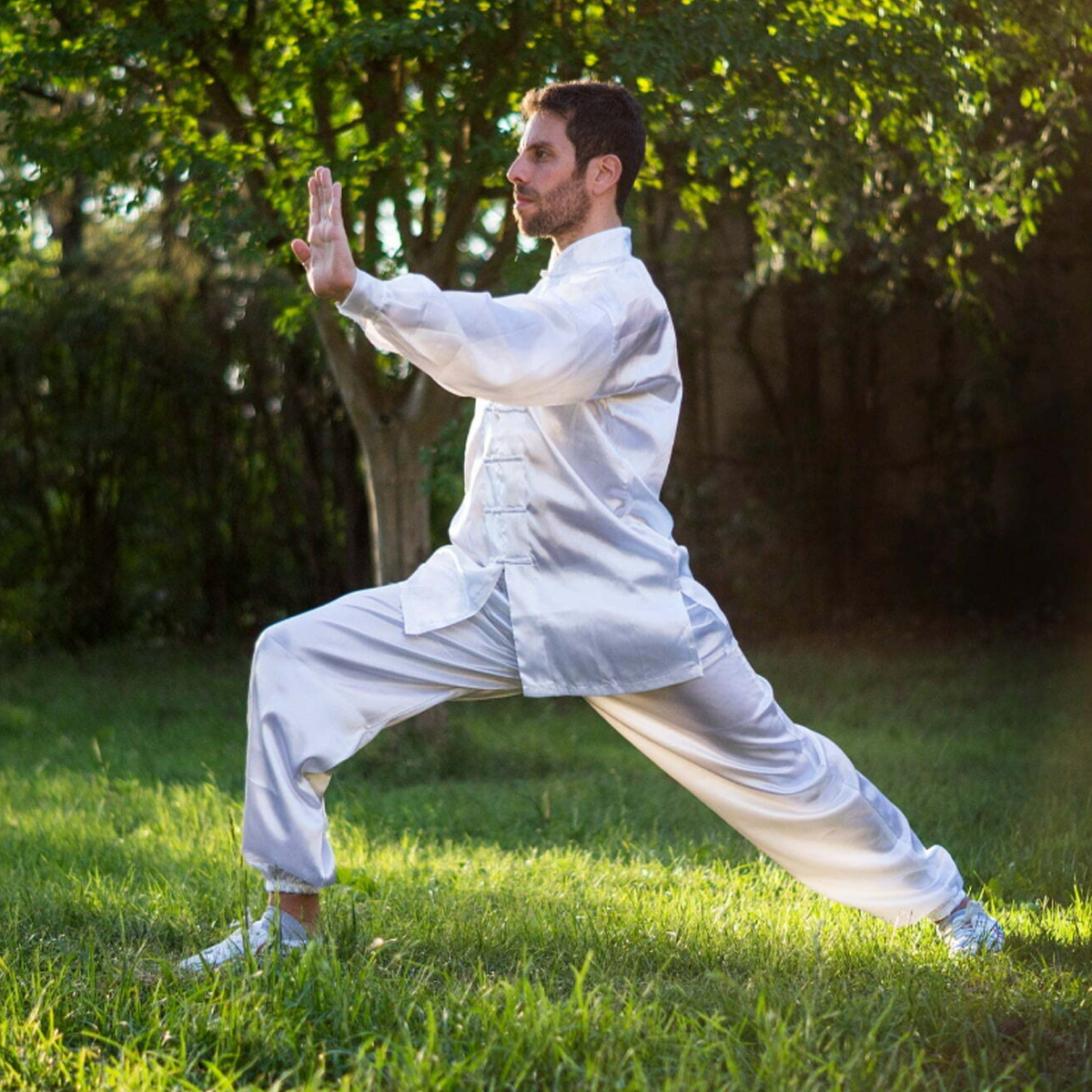
In a typical bow stance, the front knee bends while the rear leg extends behind. Weight distribution depends on the movement and style, although many variations place more weight toward the front leg.
An empty stance keeps most weight on the supporting leg. The other foot makes light contact with the ground, allowing it to move without a major shift in body position.
A horse stance uses a wider base and bent knees. Its depth varies according to the exercise and the practitioner’s ability.
Footwork connects these positions. Moving from a bow stance into an empty stance requires transferring weight before repositioning the lighter foot.
Good tai chi balance also depends on joint alignment. A deeper tai chi stance is not necessarily better if the practitioner cannot maintain control.
Breathing and Body Control
Beginners are generally encouraged to breathe naturally rather than force their breathing to match every movement.
Some schools introduce specific tai chi breathing exercises as students progress. Others emphasize posture and coordination, allowing breathing patterns to develop naturally.
Body control involves keeping the head comfortably upright, reducing shoulder tension and allowing the torso to rotate without forcing the lower back.
The movement should not come from the arms alone. In many techniques, the legs and torso initiate changes in direction, with the arms following.
Tai chi meditation is sometimes described as meditation in motion. Practitioners pay attention to breathing, posture and physical sensations while moving.
In martial instruction, similar concentration may be explained through awareness of balance, distance and positioning.
How Tai Chi Training Works
A typical tai chi lesson begins with simple movement preparation. Students may practice standing alignment, controlled stepping or shifting weight between the legs.
The instructor then introduces a section of a form or reviews movements taught previously.
Corrections often concern specific problems. A student may turn their shoulders without rotating the torso, place a foot at an awkward angle or lose alignment during a transition.
Repeating the movement after receiving feedback helps develop more reliable coordination.
Traditional tai chi training may also include standing practice, push hands, martial applications and weapons training. Common weapons include the straight sword, broadsword and spear, although availability depends on the school.
Partner drills introduce changing pressure and timing that cannot be fully reproduced in solo practice.
Students interested primarily in exercise may spend most lessons learning forms and improving movement quality.
Regular practice matters in either setting. Short home sessions can reinforce techniques already taught by an instructor, while attempting unfamiliar movements without guidance may establish habits that are harder to correct.
Tai Chi for Beginners
A beginner does not need martial arts experience or exceptional flexibility to start tai chi.
Initial lessons usually concentrate on standing comfortably, coordinating simple steps and learning a few basic tai chi movements. Students gradually combine these elements into short sequences.
Comfortable clothing and flat, flexible shoes are generally sufficient. Footwear should provide stable contact with the floor without restricting natural movement.
Beginners should avoid forcing low stances or exaggerated joint positions. A smaller movement performed with control is more useful than a larger one that causes discomfort.
People with limited mobility may benefit from modified tai chi exercises, including higher stances, shorter steps or supported movements. Seated programs are also available, although they differ from traditional standing practice.
When choosing a school, it helps to observe a lesson and ask about the instructor’s experience and teaching methods.
Someone interested in martial applications should look for structured partner work rather than assuming every class includes combat training.
Progress can be uneven. Students may memorize a short form quickly while continuing to refine its transitions and posture for much longer.
Tai Chi vs Other Chinese Martial Arts
Tai chi is sometimes presented as separate from other Chinese martial arts because public classes often emphasize slow forms rather than fighting techniques.
Historically, however, it belongs to a broader tradition involving striking, grappling, weapons and different approaches to body mechanics.
The most useful comparisons concern training objectives and the methods used to develop particular skills.
Tai Chi vs Qigong
Tai chi and qigong can look similar, particularly when both are taught through slow, controlled exercises.
Qigong is a broad category of Chinese practices involving movement, posture, breathing and focused attention. Some routines consist of individual exercises repeated several times rather than an extended sequence.
Tai chi is a specific martial art with established styles, forms and historical combat applications.
A qigong class may concentrate on a small set of breathing and movement exercises. A tai chi lesson generally involves learning connected postures and their transitions.
The distinction is not absolute. Many tai chi instructors incorporate qigong exercises into their lessons, and some modern programs combine elements of both practices.
Tai Chi vs Kung Fu
In English, kung fu commonly refers to Chinese martial arts. The original Chinese term has a broader meaning associated with skill developed through sustained practice.
Under the common English definition, tai chi is itself a form of kung fu. The popular contrast between fast, acrobatic kung fu and slow tai chi is misleading.
Chinese martial arts use different training methods. Some emphasize striking combinations and rapid footwork, while others devote more attention to grappling and close-range control.
Traditional tai chi also contains fast techniques, particularly in Chen-style training. A meaningful comparison should examine what students actually practice, including forms, partner drills, resistance training and technical applications.
Benefits of Tai Chi Practice
Tai chi attracts people with different physical abilities and training goals. Its movements can be adapted to various experience levels, although physical demands differ between programs.
Research on structured tai chi practice has found improvements in balance and reductions in fall risk among certain groups of older adults.
These findings do not mean every class produces identical results. Outcomes depend on training frequency, exercises and participant characteristics.
Tai chi also requires coordination between the upper and lower body. Repeated stepping, turning and posture changes provide opportunities to practice controlled movement.
Physical intensity varies. A gentle introductory class may involve light exertion, while traditional Chen-style training with deep stances can require considerable muscular endurance.
Some practitioners report that tai chi helps them relax or manage everyday stress. Research has examined possible benefits for sleep and psychological well-being, although the evidence varies.
Tai chi should not be treated as a cure for medical conditions or a substitute for appropriate medical care. It also does not fully replace aerobic exercise or progressive strength training.
For martial arts students, tai chi offers another benefit: a structured way to study how posture, timing and coordinated movement affect the application of force.
FAQ
Is tai chi suitable for complete beginners?
Yes. Many classes accept students without previous experience. Introductory training usually covers posture, basic footwork and short movement sequences.
How long does it take to learn a tai chi form?
A short form may take several weeks or months to memorize, depending on practice frequency and instruction. Performing it with consistent balance and coordination takes longer.
Is tai chi physically demanding?
It depends on the class and style. Gentle programs may be accessible to people with limited fitness, while traditional training with deep stances can require substantial strength and endurance.
Can tai chi help improve balance?
Research suggests that structured tai chi programs can improve balance and reduce falls in some older adult populations. Results vary according to the individual and training program.
Can you practice tai chi without learning to fight?
Yes. Many classes focus on exercise, coordination and traditional forms without requiring students to study combat applications or participate in sparring.